The Voice of the employee: What the NHI ConCourt hearings teach us about modern benefit design
May 27, 2026
ASI Financial Services, Healthcare, Healthcare Policy & NHI, Independent Financial Advice, NHI, Retirement Advisory
3 min readThe 71% Problem: why hard work no longer feels like financial progress
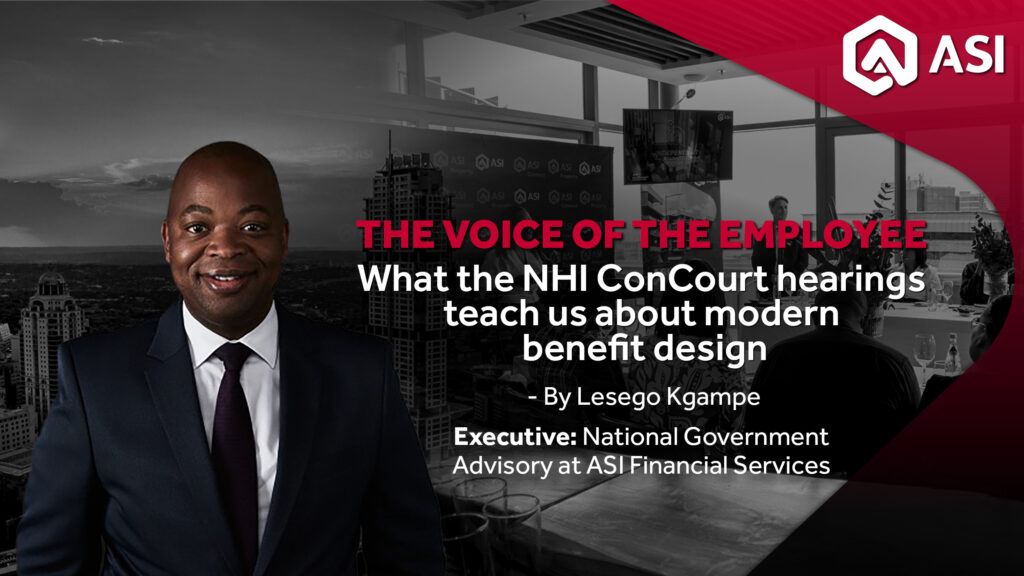
By Lesego Kgampe Executive: National Government Advisory at ASI Financial Services
The recent legal proceedings are not an ideological battleground, nor are they an attempt by the
private sector to block national unity. Rather, they represent a healthy, vital democratic process.
The hearings focus on a shared constitutional priority: ensuring that public participation,
stakeholder funding models, and operational anxieties are fully integrated so that the eventual
rollout is structurally sound and sustainable for everyone.
For corporate South Africa, this legal transition period is not a cue to step aside. It is a powerful
masterclass in active listening and a clear signpost for the future of workplace benefit design.
At ASI Financial Services, we see our role as the architects of a bridge toward a shared
destination: a Hybrid Healthcare Future where the public and private sectors complement one
another to build a healthier nation.
1. Elevating employee dialogue beyond the “Checkbox”
A core theme of the ConCourt deliberations was the process of stakeholder consultation
specifically, how deeply citizen and industry feedback was integrated into the final legislative text.
In democracy, as in business, true engagement requires moving beyond a formal, box–ticking
exercise and into the realm of qualitative, interactive dialogue.
This dynamic offers a direct lesson for the C–suite. Too often, corporate wellness programs and
medical aid choices are managed as passive, compliance–driven payroll lines. Organizations
frequently roll out a standardized health plan once a year to tick an HR box, without deeply
evaluating the diverse, real–world needs of their evolving workforce.
Just as the state seeks to build a healthcare system that reflects the needs of the collective
populace, forward–thinking employers must implement interactive, data–driven listening
strategies within their own organizations. By directly consulting employees on whether they
require localized primary care, robust support for chronic conditions, or flexible medical savings
accounts, businesses ensure their internal benefit design mirrors the national mandate for
responsive, human–centric care.
2. Dignity, equity, and the power of choice
As Dr. Nicholas Crisp, Deputy Director–General of NHI, highlighted at our recent ASI Sandton
roundtable, the moral imperative of the NHI, pooling resources for the public good is a shift that
business leaders must constructively embrace. The national vision focuses on macro equity and
funding solidarity.
Simultaneously, the corporate sector has a complementary responsibility: managing micro–level
workforce realities. A single, rigid health framework cannot adequately serve a multi–generational
workforce spanning completely different life stages.
Real equity in the workplace means providing fair access to the right care. A 23–year–old graduate
entering the corporate world may prioritize digital mental health tools and flexible primary care.
A 55–year–old manager requires comprehensive chronic disease management and gap–cover
protection. Offering flexible, tailored benefit options honors individual dignity, aligns with the
national spirit of inclusive care, and serves as a powerful talent retention tool during a time of
systemic change.
3. Rejecting the boardroom risk of “Wait and See”
Because the ConCourt has reserved its judgment to carefully weigh the arguments, some
corporate boards may be tempted to adopt a passive “wait–and–see” approach, freezing their
health benefit strategies until absolute regulatory certainty arrives.
However, at ASI we emphasize that healthcare is no longer just an HR line item; it is a critical
strategic risk. Waiting for the final legal gavel to fall before future–proofing your business
introduces a three–fold boardroom risk:
• Financial Sustainability: Navigating a double–cost danger zone where companies risk
paying twice for overlapping primary care services if they do not realign their payroll
structures early.
• The Talent War: Failing to guarantee seamless, uninterrupted access to quality care
during national healthcare flux, which weakens employee retention.
• Benefit Duplication: Facing operational friction and administrative bottlenecks by not
proactively adjusting corporate remuneration and medical scheme frameworks ahead
of time.
The future is not a binary choice between private and state care; it is Hybrid. In this model, the
NHI provides the foundation for universal access to primary care, emergency services, and
screenings. Forward–thinking employers will then step in to “bridge the gap” with targeted private
cover for specialist consultations, advanced chronic disease management, and specialized
mental health support.
The ongoing health transition reminds us that the best outcomes are achieved when we design
systems centered on the people they are meant to serve. For employers, healthcare benefits are
no longer just corporate perks they are active contributions to the broader narrative of a resilient,
inclusive South Africa.
Business leaders face a distinct choice: remain passive spectators to this national
transformation and scramble to react later, or take a constructive seat at the table now. Leading
the transition means moving beyond the fear of reform and toward the opportunity of a more
equitable, productive South Africa. The system is changing, and ASI Financial Services is here to
help your organisation position itself to lead.
national spirit of inclusive care, and serves as a powerful talent retention tool during a time of
systemic change.
3. Rejecting the boardroom risk of “Wait and See”
Because the ConCourt has reserved its judgment to carefully weigh the arguments, some
corporate boards may be tempted to adopt a passive “wait–and–see” approach, freezing their
health benefit strategies until absolute regulatory certainty arrives.
However, at ASI we emphasize that healthcare is no longer just an HR line item; it is a critical
strategic risk. Waiting for the final legal gavel to fall before future–proofing your business
introduces a three–fold boardroom risk:
• Financial Sustainability: Navigating a double–cost danger zone where companies risk
paying twice for overlapping primary care services if they do not realign their payroll
structures early.
• The Talent War: Failing to guarantee seamless, uninterrupted access to quality care
during national healthcare flux, which weakens employee retention.
• Benefit Duplication: Facing operational friction and administrative bottlenecks by not
proactively adjusting corporate remuneration and medical scheme frameworks ahead
of time.
The future is not a binary choice between private and state care; it is Hybrid. In this model, the
NHI provides the foundation for universal access to primary care, emergency services, and
screenings. Forward–thinking employers will then step in to “bridge the gap” with targeted private
cover for specialist consultations, advanced chronic disease management, and specialized
mental health support.
The ongoing health transition reminds us that the best outcomes are achieved when we design
systems centered on the people they are meant to serve. For employers, healthcare benefits are
no longer just corporate perks they are active contributions to the broader narrative of a resilient,
inclusive South Africa.
Business leaders face a distinct choice: remain passive spectators to this national
transformation and scramble to react later, or take a constructive seat at the table now. Leading
the transition means moving beyond the fear of reform and toward the opportunity of a more
equitable, productive South Africa. The system is changing, and ASI Financial Services is here to
help your organisation position itself to lead.